The Development of the U.S. Army Motorcycle Dispatch Service
from the Punitive Expedition in Mexico through World War I
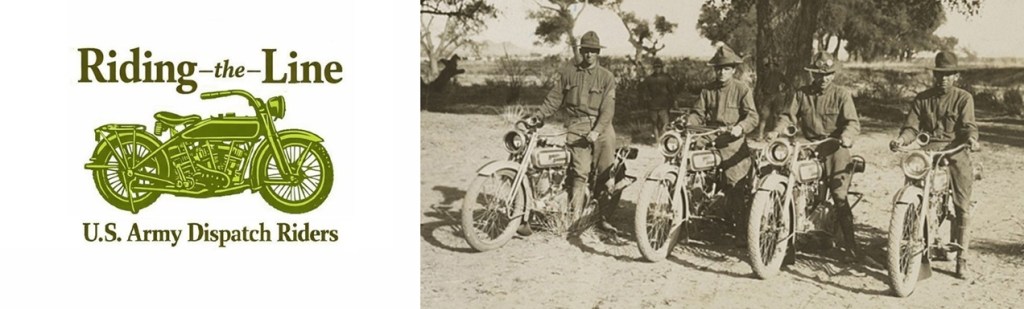
The first American use of motorcycles in combat
Pancho Villa’s March 9, 1916, raid on Columbus, New Mexico, a retaliatory attack against what he saw as betrayal by the U.S., prompted President Woodrow Wilson to launch the Punitive Expedition into Mexico to capture Villa and neutralize his forces. General John “Black Jack” Pershing crossed the border six days later in command of a force of nearly 7,000 infantry, cavalry, and artillery soldiers, along with the supporting 1st Aero Squadron, to pursue Villa. Pershing’s command also included a small but significant mechanized innovation: motorcycles and riders. Initially employed for reconnaissance and light attack raids, these assets soon demonstrated their value in the harsh Mexican terrain. Their mission later expanded to include courier duties to improve command and control across the force’s dispersed units. This early experiment marked the first American use of motorcycles in combat and laid the foundation for the U.S. Army Signal Corps Motorcycle Dispatch Service (MDS) of World War I.
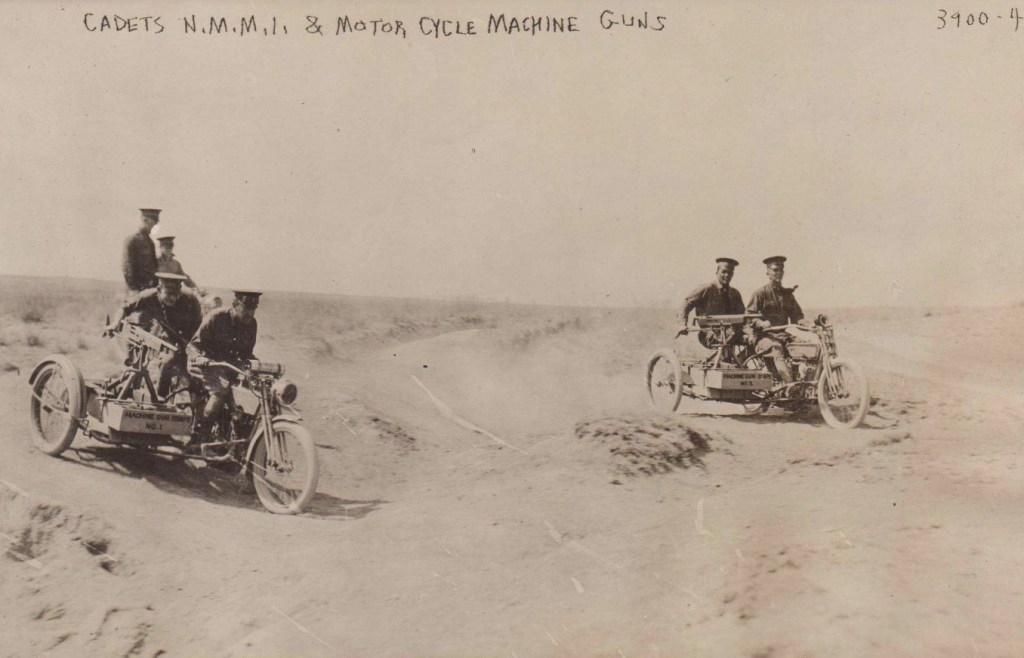
New Mexico Military Institute, Machine Gun Corps #1, 1916.
Instead of presenting the story of the early dispatch riders and the MDS as a colorful, yet overlooked, contribution to military history, this study examines how the U.S. Army adopted a bold new method of transmitting orders and information at a moment when modern warfare demanded faster, more flexible communication. Dispatch riders operated at the leading edge of Army modernization, bridging the gaps between horse‑based mobility, unreliable telegraph lines, and emerging radio communications capability. As the mission evolved, so did the riders’ occupational identity, one shaped by danger, technical skill, self-sufficiency, and a liminal position between their headquarters and the front lines. Their experience paralleled the creation of other specialized military cultures, including aviators, and later, paratroopers and other elite forces.
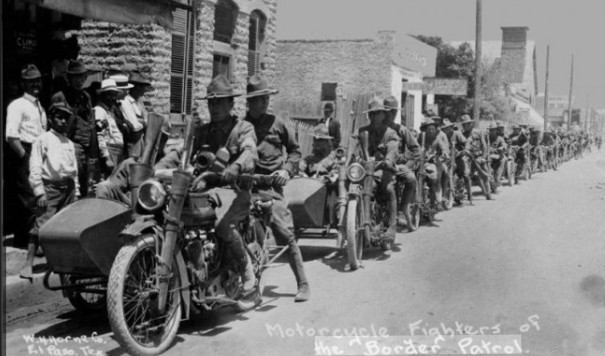
Motorcycle “fighters” on border patrol duty, 1916.
Historiographical Significance
There are extensive histories compiled on the Punitive Expedition and World War I, but dispatch riders, particularly American riders during the Great War, remain noticeably underrepresented in the literature. When they appear at all, they do so in fleeting references or photographs buried in official reports. This study challenges that lack of recognition. It asserts that dispatch riders were critical participants in the U.S. Army’s transition from nineteenth-century communication systems to twentieth-century modern, mobile command and control.
The study also questions narratives that portray technological change as smooth, linear, or inevitable. Dispatch riders earned their place through improvisation and trial and error. Their work reveals how modernization depended not only on machines or doctrine, but on the lived experiences of soldiers who navigated risk and hardship to accomplish their mission.
Finally, the study contributes to scholarship on civilian and military interaction by tracing how military and commercial motorcycle cultures shaped one another during a formative period for both. Finally, this study argues that dispatch riders were essential agents of U.S. Army modernization. Their technical contributions and the occupational identity they forged under conditions of danger and isolation reveal that the modernization of military communication relied as much on human adaptation as on technological innovation.
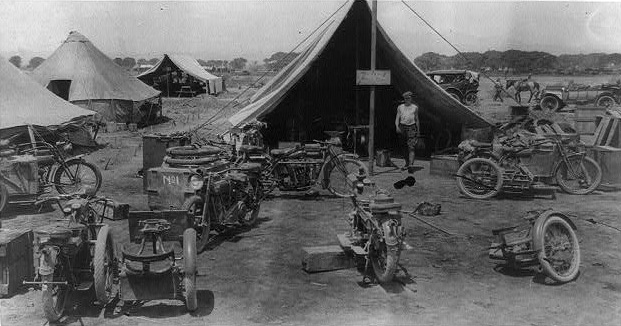
Punitive Expedition Motorcycle and Machine Gun Repair Shop, 1916.
Research Questions
To explore the social and cultural development of dispatch riders from the early experiment in modernization in Mexico to a fully institutionalized program in World War I, this study establishes five research questions. These questions situate the study at the intersection of several historical fields: U.S. military history; the history of technology, modernization, and mobility; and the social and cultural history of occupational risk and masculinity. The questions are:
1. To what extent did the Punitive Expedition serve as a proving ground for motorcycle operations, and how did the lessons learned there shape future norms of the mission?
2. How did the physical risks of military motorcycle riding (terrain, weather, mechanical failure, and enemy fire) shape riders’ self‑perception and group cohesion?
3. How did the liminal position of dispatch riders, operating between headquarters and frontline units, shape their understanding of their role in the military hierarchy?
4. How did Army leadership, training manuals, and wartime propaganda portray motorcycle riders, and how did those portrayals shape or conflict with the riders’ own self‑understanding?
5. How did interactions with civilian and motorcycle culture (e.g., Harley‑Davidson, Indian Motorcycle Company, Excelsior, and others) influence the dispatch riders’ identity?
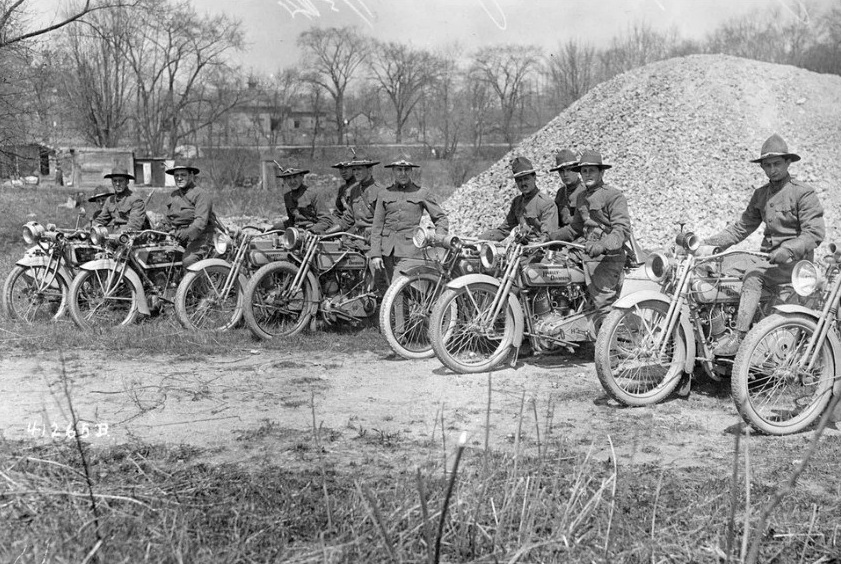
U.S. Army troops at Fort Myer, VA, in preparation for World War I, 1917.
Timeline of the study and methodological models
This study spans the period from the beginning of the Punitive Expedition (March 15, 1916) through the signing of the Armistice of World War I (November 11, 1918). Its methodological approach draws from several scholarly traditions. From military history, it examines command structures, doctrine, and organizational adaptation. From the history of technology, it analyzes how institutions, designers, and users shape the adoption and meaning of new technologies. From social and cultural history, it explores how risk, speed, isolation, and danger contribute to the construction of identity. Incorporating civilian motorcycle culture also allows the study to trace influences that flowed into and out of the Army, treating Harley‑Davidson and Indian Motorcycle Company not merely as distributors, but as cultural contributors who helped shape identity in both the civilian and military riding communities.
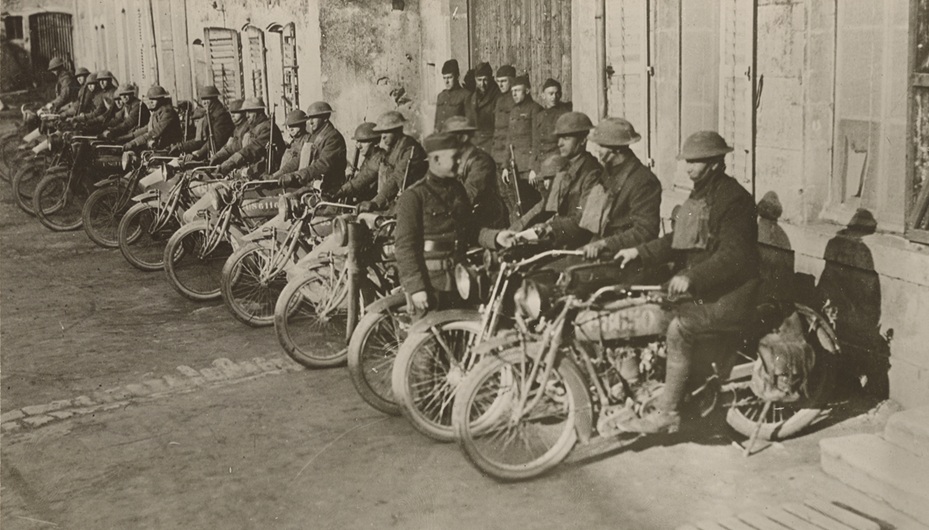
Motorcycle couriers of the headquarters troop of the 88th American Division aligned for official inspection in Lagney, France, 1918.
What this project hopes to uncover
Ultimately, this study aims to show the overlooked but intrinsic value of dispatch riders, not only for their contributions to the success of specific campaigns, but also to the Army’s broader effort to modernize its warfighting capability. It demonstrates how small contingents of soldiers navigated the areas between the headquarters and the front lines, treacherous terrain and weather, mechanical issues, isolation, and enemy fire to complete their mission. This mix of challenges and experiences shaped how dispatch riders saw themselves and were seen by others. By illuminating their contributions, this study adds a new chapter to both military and motorcycle history, one in which dispatch riders routinely operated in combat, often unheralded, on the road between orders issued and orders received.
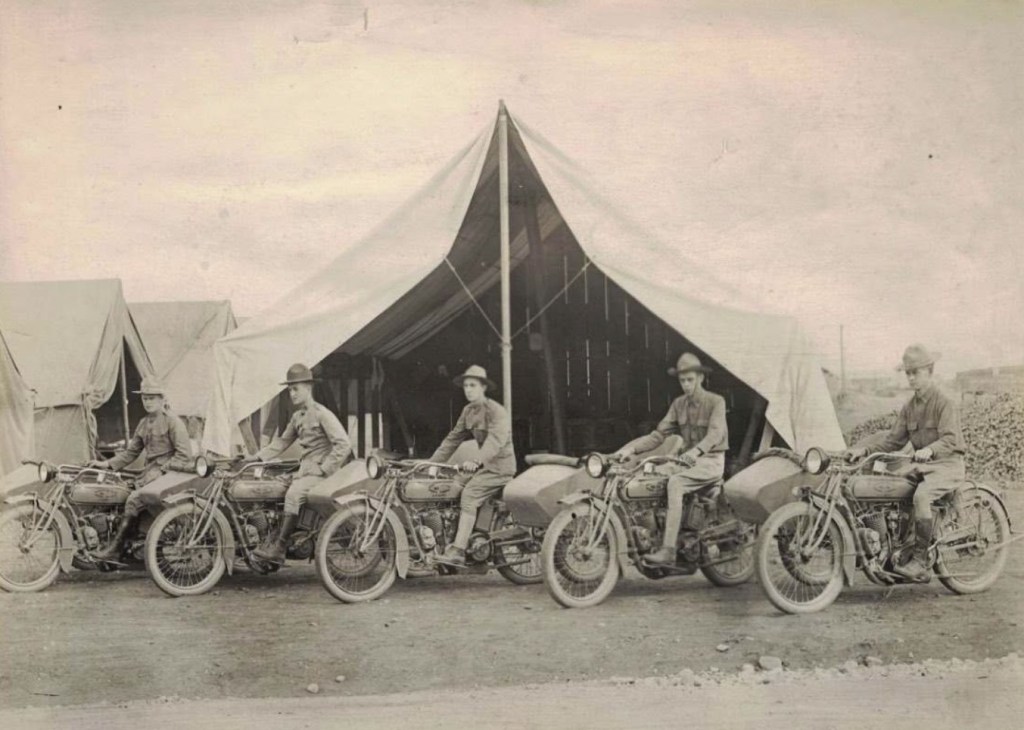
World War I Aviation Section Signal Corps Dispatch Riders, 1918.
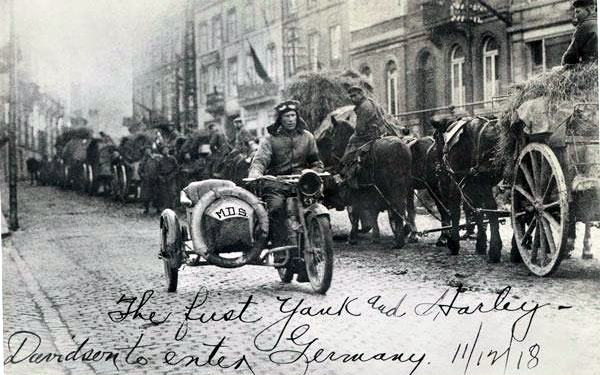
Corporal Roy Holtz, dispatch rider for the 32nd “Red Arrow” Infantry Division. He is widely recognized as the first U.S. soldier to enter Germany after the signing of the WWI Armistice
 Riding-the-Line